
IT’S TIME TO PRIORITISE THE NIGHT
Why Good Sleep Is the Closest Thing We Have to a Magic Pill
LISTEN TO THIS AS A PODCAST:
If there really was a magic pill that improved your mood, sharpened your thinking, reduced your appetite, boosted your energy, improved your recovery, strengthened your immune system, and perhaps even helped you live a little longer, we'd all be queuing around the block to get it.
The pharmaceutical company that invented it would become one of the richest businesses on Earth.
Doctors would prescribe it.
Celebrities would endorse it.
Health influencers would make endless videos about it.
Yet the funny thing is that we already know what that magic pill looks like.
It's called a good night's sleep.
The problem is that most of us spend decades treating it like an optional extra.
I know I certainly did.
For most of my life, sleep was something I squeezed around everything else. It was the thing that happened after the important stuff was finished.
Work came first.
Family came first.
Social life came first.
Travel came first.
Sleep simply got whatever time was left over.
Looking back, I now realise I spent nearly fifty years getting sleep wrong. And strangely enough, it wasn't until my sixties that I finally began to understand just how important it was.
Today, I consider sleep to be the foundation of almost everything else I do.
Walking.
Exercise.
Healthy eating.
Productivity.
Mood.
Patience.
Resilience.
All of it starts with sleep.
And while I'm certainly no sleep scientist, I have accidentally conducted a very long personal experiment.
I've lived through decades of poor sleep, inconsistent sleep, interrupted sleep, jet-lagged sleep and sleep deprivation. And I've also experienced what happens when sleep finally becomes a priority.
The difference is extraordinary.
Fifty Years of Getting it Wrong
Like many people, I wasn't exactly a model student when it came to sleep during my teenage years. I was far too busy being young.
Late nights.
Parties.
Socialising.
The occasional morning when getting out of bed for college felt more like a negotiation than a certainty.
At that age you feel almost indestructible. You can survive on very little sleep and somehow still function.
At least that's what it feels like at the time.
Then came my twenties.
For much of that decade I worked in late-night businesses. My schedule was completely out of step with the rest of society. Going to bed at three or four o'clock in the morning wasn't unusual.
While most people were getting ready for work, I was often just getting home.
The strange thing about living that way is that it starts to feel normal.
But it isn't.
Even years after I left that industry, it took a surprisingly long time for my body clock to adjust.
Then came my thirties.
Career building.
Young family.
Mortgage.
Responsibilities.
Like many parents, I spent much of that decade tired.
Not catastrophically exhausted.
Just permanently running on slightly less sleep than I probably needed.
And then my forties and fifties arrived.
If anything, things became worse.
By then I was travelling internationally almost constantly.
Airports.
Hotels.
Trade shows.
Client entertainment.
Early flights.
Late dinners.
Different time zones.
Jet lag became a regular feature of life.
And jet lag is a particularly unpleasant form of tiredness because it follows you in both directions.
You feel rough when you arrive.
You feel rough again when you come home.
Just as your body begins adapting, you're off somewhere else.
At the time, I accepted it as part of the job. Most people who travel extensively probably do.
But looking back, I can see that I spent years asking my body to perform while denying it one of its most important recovery mechanisms. Sleep wasn't a priority.
It was an inconvenience. Something to fit in when possible.
And I suspect many people listening to this will recognise some version of that story. Because modern life isn't particularly designed around good sleep.
It's designed around productivity.
Entertainment.
Availability.
Notifications.
Deadlines.
Opportunity.
Sleep often gets squeezed into whatever space remains.
The Hidden Cost of Poor Sleep
One of the reasons sleep is easy to neglect is because the consequences don't always appear immediately.
If you eat a bad meal, you often feel it quite quickly. If you pull a muscle, you know about it straight away.
Sleep works differently.
The effects tend to accumulate quietly.
A little less patience.
A little less concentration.
A little less motivation.
A little more irritability.
A few more poor decisions.
A few more cravings for sugary foods.
A few more cups of coffee needed to get through the day.
None of those things seem dramatic in isolation. But over weeks, months and years, they begin adding up.
Sleep influences far more than simply how tired you feel.
It affects memory.
Learning.
Judgement.
Reaction times.
Mood regulation.
Recovery.
Even appetite.
REAL WORLD DANGER
One of the more sobering things I discovered while researching this topic is that a significant proportion of early-morning road accidents involve sleep-deprived drivers. People whose reaction times and decision-making abilities are impaired simply because they haven't slept properly.
In some cases, the effects of sleep deprivation can resemble the cognitive impairment associated with alcohol. That's a remarkable thought when you stop and consider it.
Most of us would never dream of driving after several drinks.
Yet many people think nothing of driving after a seriously poor night's sleep.
The truth is that when we're sleep deprived, we're often not the best judges of how impaired we really are. Which is another reason sleep deserves more respect than it usually receives.
The Great Discovery
The funny thing is that I didn't set out to become interested in sleep. I certainly didn't wake up one morning and decide to become what I now jokingly describe as a sleep obsessive.
It happened gradually.
Almost accidentally.
As I moved into my sixties, my life began changing. I was no longer living the same lifestyle.
There were fewer late nights.
Far less travel.
Fewer social obligations.
Fewer disruptions.
I was living alone.
Life became simpler.
And with that simplicity came something I'd never really had before.
Control.
For perhaps the first time in my adult life, I had almost complete control over my evening routine.
I could choose when to go to bed.
I could choose what happened before bedtime.
I could control the noise levels.
Light levels.
Meal times.
Alcohol.
Distractions.
And once those variables started disappearing, something interesting happened.
Great sleep simply started happening too.
Sleep Became the Foundation
What surprised me most wasn't that I started sleeping better.
What surprised me was how many other things improved as a result.
For years, I'd thought of sleep as one health habit among many.
Important, certainly. But no more important than exercise, diet, stress management or any of the other things people talk about.
I don't think that anymore.
Today, I see sleep as the foundation underneath all the others.
If I sleep well, I'm far more likely to make good decisions the following day.
I'm more likely to exercise.
More likely to walk.
More likely to eat sensibly.
More likely to be patient.
More likely to be productive.
More likely to enjoy my day.
It's not that good sleep magically solves every problem. Life still happens.
Difficult things still happen.
Unexpected things still happen.
But I find myself far better equipped to deal with them.
A good night's sleep doesn't eliminate challenges. It simply gives you more resources to handle them.
The best way I can describe it is this:
Everything feels easier.
Not easy.
Just easier.
And when you stack enough easier days together, they become a better life.
These days I'm usually in bed by around ten o'clock.
The lights are off.
The room is dark.
And most nights I'm asleep fairly quickly.
Around six o'clock in the morning I'm naturally awake and ready to start the day.
According to my sleep tracker, I average about 7.2 hours of sleep each night, over the course of a year. That may not sound especially impressive. But for me, it works.
I rarely feel tired.
I rarely nap.
I almost never find myself yawning through the day.
In fact, if I do start yawning, it's usually my signal that bedtime is approaching.
For the vast majority of my waking hours I feel alert, present and aware. That wasn't always true.
And because I remember the contrast so clearly, I don't take it for granted.
CASCADING BENEFITS
One unexpected benefit is that I've become much better at relaxing. When you're properly rested, you can sit quietly without feeling as though you're about to fall asleep. You can watch a film without nodding off halfway through.
There's a big difference between relaxation and exhaustion. For much of my life, I think I confused the two.
the 2% Improvements That Changed Everything
People often ask for the one thing.
The magic trick.
The secret.
The sleep hack.
The single change that transformed everything.
The truth is slightly less exciting.
I don't think there was one thing. I think there were lots of little things.
Tiny improvements.
Marginal gains.
Two-percent improvements that eventually accumulated into something significant.
On their own, none of them seemed revolutionary. Together, they changed everything.
For example, my bedroom is now deliberately sparse.
Comfortable, yet Minimal.
Functional. And always clean and tidy.
Apart from getting dressed, I don't really use it for anything except sleeping.
There's no television.
No distractions.
No temptation to stay up watching one more episode of something.
For years I was convinced total darkness was the key.
Eventually I discovered a much simpler solution.
A comfortable sleep mask.
Mine cost around ten pounds.
Nothing fancy.
But it completely solved a problem that had irritated me for years.
During the summer months I'd often wake earlier than I wanted because daylight was creeping into the room.
The mask fixed that immediately. It fists beautifully and its got soft foam round the edges so you can open your eyes freely, and you’re in pitch darkness
More importantly, it helped keep my sleeping environment consistent throughout the year.
Winter.
Summer.
Light mornings.
Dark mornings.
My brain receives the same signal every night.
It's time to sleep.
Then there are the obvious things that everybody already knows.
Alcohol.
Caffeine.
Heavy late meals.
Most of us understand these things intellectually. The challenge is applying them consistently.
I still enjoy a drink from time to time. I'm not interested in living like a monk.
But I also know from experience that several drinks late in the evening will almost certainly degrade my sleep quality.
The older I've become, the more respect I've developed for timing. Not just what I consume.
When I consume it.
The same principle applies to food. I generally eat earlier than I used to. I like giving my digestive system time to settle before bedtime.
Again, it's not dramatic.
It's not exciting.
But it helps.
And sleep seems to be one of those areas where lots of small advantages compound beautifully.
And I learned to Love Bedtime
This may sound ridiculous to some people. But one of the biggest changes wasn't physical. It was psychological.
For most of my life, I viewed sleep as an interruption.
An inconvenience.
A necessary pause before I could get back to whatever I really wanted to be doing.
Many people feel that way. They stay up later than intended because they're trying to squeeze a little more life out of the day.
One more programme.
One more chapter.
One more hour.
One more scroll through social media.
One more glass of wine.
One more anything.
I understand the feeling completely because I lived it for decades.
At some point, though, my mindset changed. I stopped viewing sleep as something that interrupted my day.
I started viewing it as the process that powered the next one.
That's a completely different relationship.
These days I genuinely look forward to bedtime.
Not because I'm exhausted.
Not because I can't wait for the day to end. Quite the opposite.
I appreciate what sleep does for me.
I value it.
I'm grateful for it.
And because I value it, I naturally protect it. The same way you would protect anything else that's important to you.
Somewhere along the way I developed a deep internal belief that quality sleep sits at the centre of healthy ageing. As long as my sleep remains strong, I feel as though everything else is more likely to stay in balance too.
That belief has become self-reinforcing.
I prioritise sleep.
Good sleep rewards me.
That reward encourages me to continue prioritising sleep.
It's a remarkably positive cycle.
My Most Controversial Sleep Opinion
Now let's venture briefly into dangerous territory. This is one of those observations that I offer cautiously because everybody's circumstances are different.
For most of my adult life, I shared a bed with my partner.
That's what couples do.
It's normal.
Expected, even.
And there are plenty of emotional, psychological and relationship benefits associated with that arrangement.
I completely understand them.
But speaking purely from the perspective of sleep quality, I have to be honest about my own experience.
I only discovered truly uninterrupted sleep after I started sleeping alone.
No movement beside me.
No different sleep schedule.
No snoring.
No duvet negotiations.
No unexpected disturbances.
Now before anybody writes an angry letter, I'm not recommending separate bedrooms. I'm not suggesting couples should sleep apart.
I'm simply reporting the results of my own accidental experiment.
When all the variables were removed, my sleep improved dramatically.
For some couples, that won't resonate at all.
For others, it might trigger a moment of recognition.
Either way, I think it's worth acknowledging because good sleep sometimes requires us to question assumptions we've never previously examined.
The Difference Between Sleeping and Recovering
Another thing I've come to appreciate is that not all sleep is created equal. You can spend eight hours in bed and still wake up feeling tired.
Most of us have experienced that.
Equally, you can sometimes sleep slightly less than usual and wake up feeling fantastic.
Recovery matters.
Quality matters.
Consistency matters.
This is why I sometimes smile when people become obsessed with exact numbers.
Was it seven hours?
Seven and a half?
Eight?
The truth is that your body tends to give you useful feedback if you're prepared to listen.
How do you feel?
How alert are you?
How quickly do you recover?
How often are you tired during the day?
Those questions often reveal more than any app.
Sleep trackers can be useful. I use one myself.
But ultimately the most important measurement is how you feel when you wake up and how you function throughout the day.
Because that's what we're really trying to improve.
Not a number.
A life.
Protect Your Sleep and Your Sleep Will Protect You
Looking back, I spent much of my life searching for ways to feel better.
More energy.
More focus.
More productivity.
More resilience.
More health.
More enjoyment.
Like many people, I often looked outside myself for the answer.
The next strategy.
The next system.
The next breakthrough.
What surprises me now is how many of those improvements were quietly sitting behind a bedroom door all along.
Sleep isn't glamorous. Nobody boasts about going to bed on time.
There are no social media influencers posting photographs of themselves asleep.
There are no dramatic before-and-after pictures.
No miracle cure.
Instead, sleep works quietly.
Patiently.
Night after night.
Year after year.
And perhaps that's why it's so easy to underestimate.
Yet if my own experience has taught me anything, it's that protecting your sleep may be one of the highest-return investments you can ever make.
Not because it guarantees perfect health.
Not because it solves every problem.
But because it improves your ability to deal with almost everything else.
I've lived both versions.
I've lived the late nights.
The disrupted routines.
The jet lag.
The constant tiredness.
And I've lived the version where sleep became a genuine priority.
Given the choice, I wouldn't go back.
Not for a second.
These days I happily organise large parts of my life around protecting my sleep. Some people might consider that restrictive.
I consider it liberating.
Because every morning I wake up rested, clear-headed and ready for another day. And at this stage of life, that's a gift I no longer take for granted.
So if you're looking for a place to start your own healthy ageing journey, you could do far worse than beginning tonight.
Not with a supplement.
Not with a complicated fitness programme.
Not with another health gadget.
Just with an earlier bedtime.
A darker room.
A quieter evening.
And a little more respect for the most powerful recovery system your body already possesses.
Protect your sleep.
And your sleep will protect you.
Take the Next Step
If this article has given you something to think about, you might like to spend another five minutes with the short audio session below.
It's a brief guided activation based on the principles of rapid hypnosis, designed to help you settle these ideas, clarify your thinking and begin translating intention into action.
Whether you decide to adopt a Great Sleep Mindset or simply explore it further, the audio provides an opportunity to pause, reflect and mentally rehearse the kind of small, consistent decisions that often lead to lasting change.
Whenever you're ready, kick back and relax, and just press play (but not whilst driving!).
THANK YOU
Thanks for spending a little time with me today.
I'm Rick Smith, and you'll find many more articles, audio features and practical hypnotherapy programs throughout my website, all designed to help you live a healthier, calmer and more fulfilling life.
Feel free to explore while you're here, and if you'd like to hear about future articles and audio releases, check back regularly.
Until next time, take good care of yourself... and remember, it's not just about adding years to your life; it's about adding life to your years.
BROWSE MY POSITIVE AGING HYPNOSIS PROGRAMS
LOOKING FOR SOMETHING MORE PERSONAL?
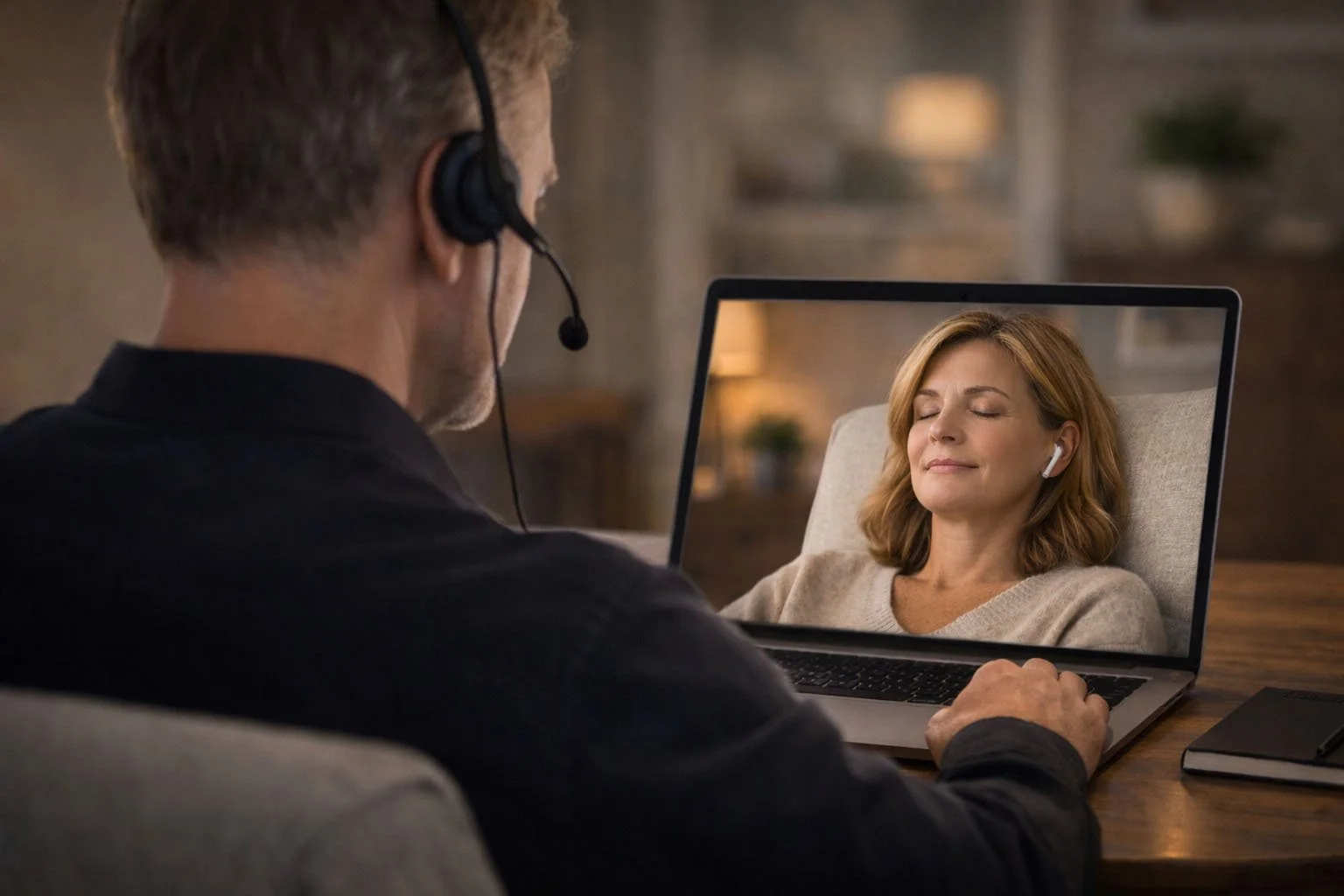
One-To-One online Hypnosis Sessions Now Available
If you’re looking for something more personal, You might be interested in this:
You can now book a private online hypnosis consultation with me, from anywhere in the world.
Appointments are tailored to your individual needs and scheduled at a time that's convenient for you.
If here’s a change you want to make, I’d be happy to help you achieve it!
BROWSE MY health & vitality HYPNOSIS PROGRAMS