
H1 PAGE TITLE TEXT
H2 PAGE DESCRIPTION

If you're considering a live hypnosis session with me, it's perfectly natural to have questions.
The articles and recordings on this page are here to help you understand the process, know what to expect, and feel comfortable before we meet. They explain how I work, how my approach evolved, and how to get the very best from your session, all in the same straightforward, conversational style you'll experience when we work together.
There's no pressure to read or listen to everything. Simply explore the topics that interest you, and if you still have a question afterwards, just get in touch. I'd much rather answer it before your session than have you arrive wondering.
For July & AUGUST, save 30% on your first full-hour appointment.
Use code LIVE30 when booking, and pay just $87.50 instead of $125.
1: Understanding the Process
If you've experienced hypnosis before, you may notice that these sessions feel a little different.
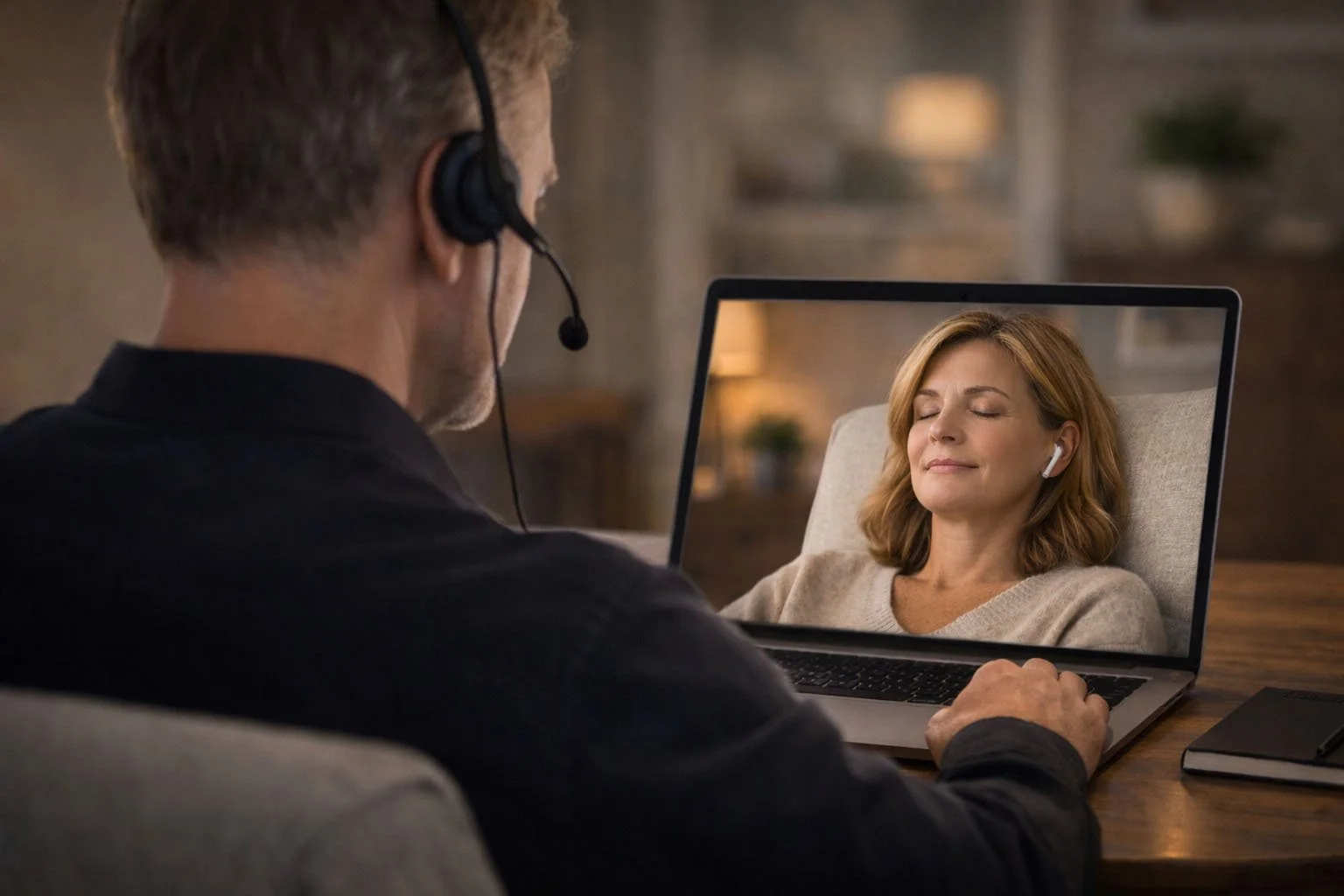
That's not because traditional hypnosis is wrong. In fact, many of the familiar techniques have stood the test of time for good reason. Relaxation, focused attention and carefully chosen language all have an important place in helping people change.
But like most professions, hypnotherapy hasn't stood still.
Over the past few years, thanks to advances in psychology and neuroscience, we've learned far more about how habits form, how emotions influence decisions, how the brain predicts and responds to experience, and why two people with the same problem can need completely different solutions.
Alongside that, the move towards online therapy encouraged many practitioners to rethink what was truly essential, and what was simply tradition.
As a result, my sessions have evolved to reflect what I've found works best with real people facing real problems.
That often means spending a little more time understanding what's happening beneath the surface before trying to change it.
Many people come to me believing they already know what the problem is. Sometimes they're right. Sometimes they're describing the symptom rather than the cause. If we focus only on the obvious problem, we can end up working very hard without creating lasting change.
Instead, I try to identify the process that's keeping the problem alive.
For one person, anxiety may be driven by constant overthinking. For another, it may stem from a deeply ingrained need to stay in control. Someone who wants to drink less may not have an alcohol problem at all; they may have developed an evening ritual that has become their mind's automatic way of changing emotional state. On the surface those situations can look similar, but they rarely respond to exactly the same approach.
That's why no two sessions are ever identical.
Sometimes we'll spend longer talking than you expected. Sometimes we'll move into hypnosis quite quickly. Occasionally we'll discover that the issue you booked the session for isn't actually the one that's creating the greatest difficulty.
None of that is accidental.
It's simply part of understanding the problem well enough to solve the right one.
When we do move into hypnosis, the experience itself may also feel a little different from what you've imagined. There's no need to perform, no pressure to "go deep", and no expectation that you'll lose awareness or control. For most people, it feels more like becoming deeply absorbed in the conversation than drifting into a mysterious state where things happen without your knowledge.
The aim isn't to make hypnosis the most memorable part of the session.
The aim is to create meaningful change that still feels natural when you return to everyday life.
Everything we do is designed around that outcome.
If you come to your session with curiosity rather than expectations about exactly how hypnosis should feel, you'll almost certainly get far more from the experience.
After all, the goal isn't to recreate somebody else's idea of hypnosis.
It's to help you create the change you came for.
2: What Happens During a Session?
From the moment you book your session, the aim is to make your whole experience as straightforward and relaxed as possible.
Once your booking is confirmed, you'll receive everything you need, including a simple Zoom link and a short intake form. The form gives me an opportunity to understand a little about your situation before we meet, but it doesn't replace the conversation we'll have together. It's simply a starting point.
At the beginning of the session, we'll spend some time talking.
This isn't just a friendly chat or a box-ticking exercise. It's often one of the most valuable parts of the session. Together, we'll explore what's been happening, how it affects your life, what you've already tried, and, perhaps most importantly, what you'd like to be different.
While we're talking, I'm doing more than simply gathering information. I'm also paying close attention to how you naturally think, communicate and respond. That allows me to shape the session around you, choosing the language, pace and style of communication that are most likely to connect with the way your mind already works.
Sometimes we'll discover that the issue you originally wanted to work on is exactly the right place to begin. Sometimes something more important reveals itself as we talk. Either way, the goal is to understand the problem clearly before we begin changing it.
By the time we move into hypnosis, the session has already begun.
Once we've built that understanding together, I'll guide you through a short spoken preamble that gently sets the scene for the work we're about to do. It creates the mental landscape, brings your attention into focus, and prepares the way for what follows.
From there, the transition into hypnosis is usually so natural that many people couldn't tell you exactly where the conversation ended and hypnosis began. It simply becomes more focused, more immersive and more inwardly directed.
Over the years, this gradual, integrated way of working has consistently proved to be the most natural and productive approach for the people I help. Rather than separating the conversation, the hypnosis and the therapeutic work into distinct stages, each part flows into the next, allowing the session to develop as one continuous experience.
From that point on, every session follows its own path.
Sometimes we're untangling an old pattern. Sometimes we're building a new way of responding. Sometimes we're reconnecting you with strengths or abilities that have simply become buried beneath stress, habit or self-doubt. The direction we take depends entirely on what we've discovered together.
Throughout the session, you're never expected to "do hypnosis properly." There are no marks to score and no special state that you have to achieve. Your only job is to follow along as comfortably as you can. If your mind wanders occasionally, that's perfectly normal. If you need to adjust your position, that's absolutely fine.
As the therapeutic work comes to a close, I'll gradually bring you back to full alertness. Most people describe feeling calm, clear-headed and mentally refreshed. Some notice an immediate shift in how they think or feel. For others, the changes continue to unfold over the following hours and days as the mind quietly begins using its new patterns in everyday life.
Before we finish, we'll spend a few minutes reflecting on the session and discussing what comes next.

For many people, a single session creates exactly the change they were hoping for. Others benefit from a second or third session to build on the progress we've already made. There's no programme you're expected to commit to in advance. We'll simply decide together, based on how things have moved and what feels most appropriate for you.
The session doesn't really end when the Zoom call finishes.
The real measure of success is what happens afterwards: the conversation that feels easier, the situation that no longer triggers the same reaction, the decision that suddenly comes more naturally, or the quiet moment when you realise you've responded differently without even having to think about it.
That's when change stops feeling like something you're trying to do, and starts becoming part of who you are.
3: Why This Approach Works
Most people don't come to a session because they lack information.
By the time they arrive, they've usually spent weeks, months or even years trying to understand what's happening. They've read books, listened to podcasts, watched videos, talked to friends and searched endlessly for answers online.
Knowledge is rarely the missing piece.
The real frustration is knowing what to do, but finding yourself slipping back into the same thoughts, emotions or behaviours anyway.
That's because most unwanted patterns don't continue through lack of willpower. They continue because the mind has learned an efficient way of responding to a particular situation. At some point, that response served a useful purpose. It solved a problem, offered protection, created relief or helped you cope.
The difficulty is that the mind doesn't automatically notice when an old solution has outlived its usefulness.
It simply keeps repeating the same process because repetition creates familiarity, and familiarity feels safe.
That's why trying harder doesn't always produce lasting change.
If the underlying process remains the same, the same outcome usually follows.
My approach is to look beyond the obvious symptom and ask a different question:
Whats keeping this pattern alive?
Sometimes the answer is surprisingly simple.
A habit that has become automatic.
An emotional response that no longer matches the situation.
A belief that made perfect sense years ago but has quietly become outdated.
Or two perfectly reasonable needs pulling in different directions, creating an internal tension that never quite resolves.
Once we understand the process, we can begin changing the process itself.
Often, surprisingly small changes upstream create much bigger changes downstream. Instead of constantly managing the symptoms, we're redesigning the system that keeps producing them.
That's why different clients who describe themselves as anxious may have completely different sessions. One may need to quiet an endless cycle of overthinking. Another may need to let go of an old responsibility they've carried for years. A third may simply need a different way of responding to uncertainty.
The label may be the same.
The solution rarely is.
Hypnosis provides the ideal environment for this kind of work because it allows us to step outside the automatic patterns that usually run unnoticed in everyday life. It becomes easier to explore different perspectives, strengthen more helpful responses and allow new patterns to begin taking root without feeling as though you're forcing yourself to change.
The aim isn't to become a different person.
It's to remove what's been getting in your way, so that more of the person you already are can come through naturally.
That's why I don't measure success by how deeply someone appeared to relax during the session.

I measure it by what happens afterwards.
When a situation that used to trigger anxiety now feels manageable.
When an old habit quietly loses its grip.
When a difficult conversation becomes easier than expected.
Or when, days later, you suddenly realise you've responded differently without even thinking about it.
Those are often the moments that matter most.
Because lasting change rarely announces itself with fireworks.
More often, it simply begins to feel like the new normal.
4: Frequently Asked Questions
Will I lose control?
No.
One of the biggest misconceptions about hypnosis comes from stage performances, where volunteers appear to hand over control completely. Therapeutic hypnosis is very different.
Throughout your session you'll remain aware of what's happening around you. You'll hear my voice, you'll be able to think, and if you wanted to stop the session at any point, you could.
Most people describe hypnosis as feeling less like being unconscious and more like becoming deeply absorbed in a conversation or a good book.
What if I can't be hypnotised?
Almost everyone can experience hypnosis when they're comfortable, willing to engage and able to follow simple instructions.
You don't need a special talent or a particular type of mind.
In fact, many analytical people are surprised by how naturally the process develops once they stop worrying about whether they're "doing it properly."
Is online hypnosis really as effective?
For the vast majority of people, yes.
In fact, many clients tell me they feel more comfortable working from their own home than they would in an unfamiliar therapy room.
The important part of the session isn't the room we're sitting in; it's the quality of the communication, the therapeutic process and the work we do together. Those translate remarkably well online, which is why I've chosen to specialise in this way of working.
How many sessions will I need?
There's no single answer because every person and every problem is different.
Many people achieve exactly what they were hoping for in a single session.
Others choose to return because they want to build on their progress, tackle another aspect of the problem, or work on something completely different.
We'll always discuss that together at the end of the session. There's never any obligation or expectation to book further appointments.
Will I remember what happened?
Quite possibly, yes.
Many clients remember the vast majority of their session. Some people notice that parts feel a little dreamlike or less distinct afterwards, but that's perfectly normal.
The important thing isn't remembering every word that was said.
It's noticing how naturally your thoughts, feelings or behaviour begin to change afterwards.
What if I've tried hypnosis before and it didn't work?
That depends on why it didn't work.
Sometimes the timing wasn't right. Sometimes the real problem hadn't yet been identified. Sometimes the approach simply wasn't the best fit for you.

Every hypnotherapist develops their own style over time, and no two practitioners work in exactly the same way.
For that reason, a previous disappointing experience doesn't necessarily predict what your experience here will be.
If you're curious rather than sceptical, it's often worth approaching a new session with an open mind rather than comparing it to the last one.
If there's something you're still wondering about after reading these pages, please don't hesitate to get in touch.
I'd much rather answer a question before your session than have you arrive with unnecessary uncertainty.
The more relaxed and informed you feel beforehand, the easier it is to focus on the reason you came in the first place.
5: Getting the Most from Your Session
One of the questions I'm often asked is whether there's anything you should do before your session to help it go well.
The good news is that there's very little preparation required.
You don't need to study anything, practise anything or arrive in a particular state of mind. In fact, the less pressure you put on yourself beforehand, the better.
The one thing that really does make a difference is creating an environment where you can be comfortable.
Comfort isn't simply about feeling cosy. It's about removing unnecessary distractions and resistance, so your mind is free to engage with the session rather than constantly being reminded where your body is.
If you're balancing on a dining chair, perched at a desk, or sitting in a position that becomes uncomfortable after a few minutes, part of your attention will naturally keep drifting back to those physical sensations. It's not a disaster if that happens, but it's one less thing for your mind to deal with if you can avoid it.
A supportive armchair, recliner or comfortable sofa is usually ideal. We'll spend the first few minutes talking together, so it's important that you can see me clearly and that I can see you. Good lighting and clear audio are far more important than having an expensive camera or microphone.
Once we've finished talking and moved into the therapeutic part of the session, many people choose to place their phone or tablet on a nearby table and simply settle back with their eyes closed. As long as you can hear my voice comfortably, that's absolutely fine.
Think of it this way:
The more comfortable your body is, the less your mind has to pay attention to it.
How to Book
Arranging your personal online hypnosis session takes just a few moments.
Choose a date and time that suits you, up to one month in advance. Sessions normally run for 45–60 minutes and begin on the hour.
As part of the booking process, you’ll be asked to complete a short Client Intake Form. This gives me the information I need to prepare properly and shape the session around what you’ve shared.
Once that’s done, you’ll complete your booking, including consent, and secure payment via Stripe (all major cards accepted), Apple Pay, Google Pay, or PayPal.
After booking, you’ll receive a confirmation email containing your Zoom link and session details.
Everything is handled securely, privately, and with care.
Simple. Secure. Convenient.